The addresses
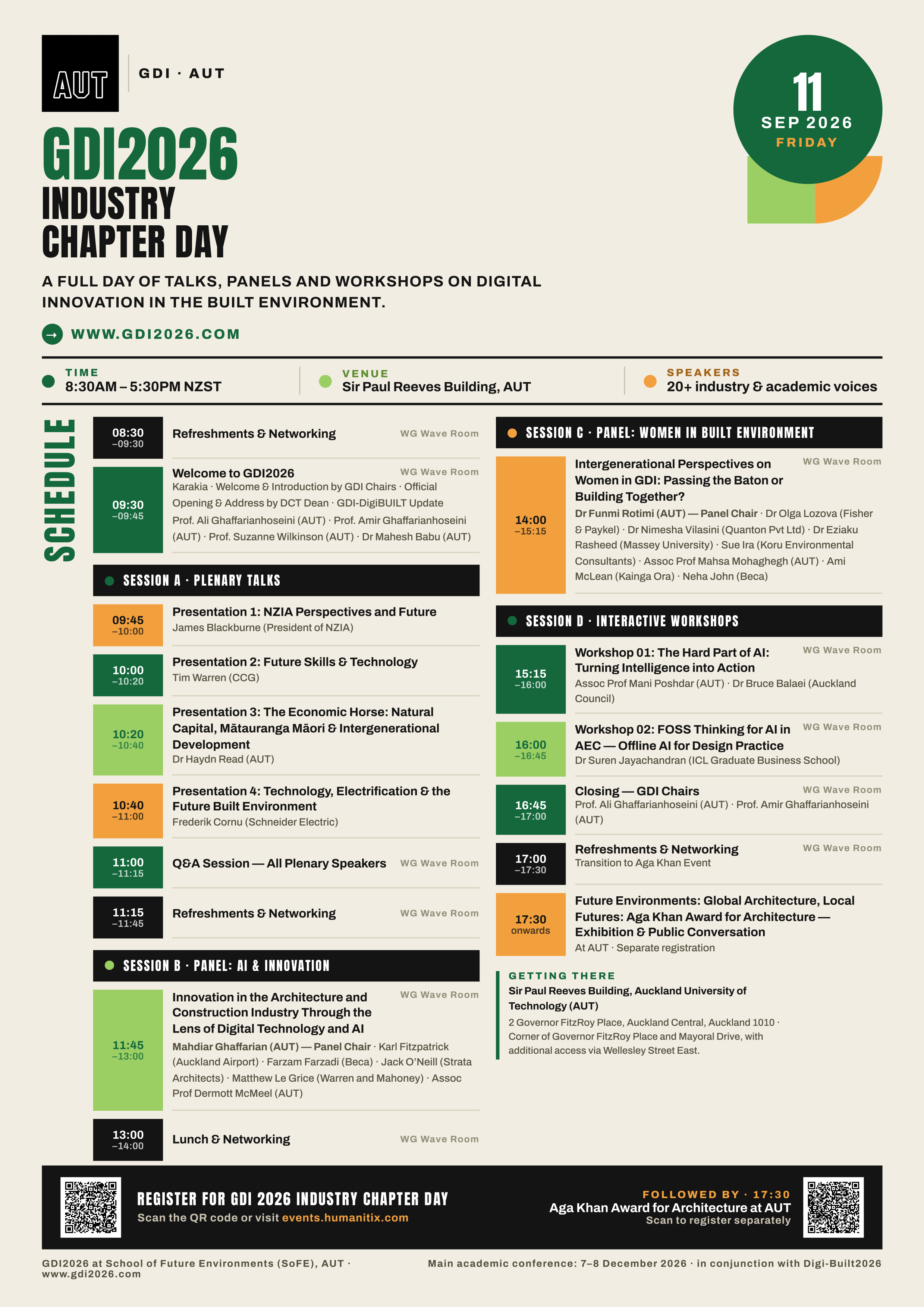
He opened the day at 9:30 with the chairs’ karakia, the formal welcome and an introduction that framed the programme, and he returned at 4:45 with his co-chair, Professor Amirhosein Ghaffarianhoseini, to close it. Between those two moments sat a full day of plenary talks, panels and workshops that he and his team had assembled as a deliberate counterweight to the research sessions of the main conference.
The day was conceived as the conference’s working session with practice. Academic conferences tend to report what has been studied; an industry chapter tests what is about to be built. Its themes, from skills and electrification to the place of mātauranga Māori in design, were chosen because they are decisions the sector faces now rather than topics for a future research agenda.
The programme
The Industry Chapter is the part of the International Conference of Green + Digital + Intelligent Built Environments built around practice. Its programme covered future skills and technologies, artificial intelligence, electrification, natural capital, mātauranga Māori, intergenerational development and the changing role of women in the built environment.
Plenary talks came from the President of Te Kāhui Whaihanga New Zealand Institute of Architects, the Construction Clients’ Group and Schneider Electric, followed by panels on AI and innovation and on women in the built environment. More than twenty speakers took part, drawn from consultancies, client organisations, suppliers, professional bodies and universities.
Why it matters
The day ran directly into the evening exhibition and public conversation for the Aga Khan Award for Architecture at AUT, on global architecture and local futures. A single programme therefore moved from the practical questions that occupy New Zealand’s industry to one of the most demanding international benchmarks for architecture, and asked the same audience to hold both in view.
For the School, the Industry Chapter is also a statement about what a university conference should be. Registration was complimentary and open to practitioners, academics, researchers and students alike, so that the people who rarely attend academic meetings had a reason to come. The decision reflects the principle he has set for GDI from its first edition: research matters most when it changes practice, policy or places beyond the university.
His part in GDI
GDI grew out of the international event series he co-founded a decade earlier and has become, under his chairing, an annual platform with published proceedings, industry partners and a global author base. Opening and closing the Industry Chapter is the most visible expression of that role: the chair sets the terms of the conversation at the start of the day and draws its conclusions at the end.