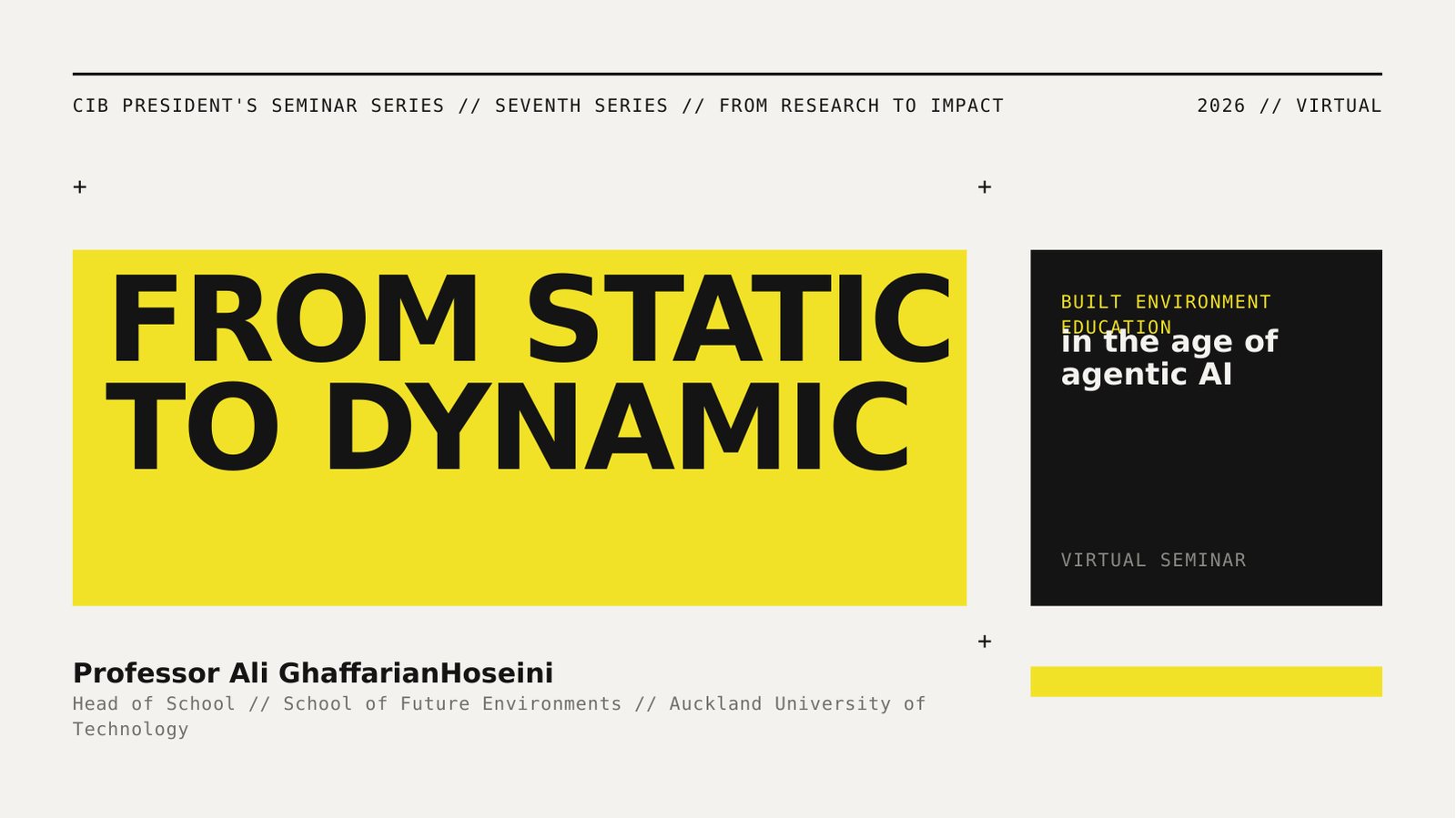
The Argument
Institutions built for a world that held still cannot produce impact in a sector that now changes in months. That is the proposition Professor Ghaffarian puts to the seventh CIB President’s Seminar Series. Curricula, assessment, partnerships and publications all assume time to plan, and the green, digital and intelligent transition of the built environment, now accelerated by agentic AI, has taken that time away. A programme designed once and reviewed every five years falls further behind practice each year between reviews, resets, and then the gap opens again.
His answer is borrowed from the sector itself. The built environment already knows how to run a system that senses, decides and acts continuously; it calls that system a digital twin. Prof Ghaffarian argues that a school should run the same way, as a loop that senses change in its ecosystem, updates its model of what graduates need, and acts in time rather than at the next review.
Timing as the Third Factor of Impact
The series asks how research in the built environment achieves impact. The usual answer counts two factors: the quality of the work and its translation into practice. The address adds a third, timing. Work of high quality that arrives after the sector has moved delivers less than it should, and timing is the factor a slow institution loses first. Framed this way, education sits inside the series’ question rather than beside it, since graduates are one of the main routes by which research reaches practice.
What Has to Change
Each change is named with its mechanism and its cost. Curricula separate a stable core, guarded over years by programme committees, from a volatile layer that module owners update within an agreed envelope. Assessment moves from the finished artefact, which AI can now produce, to the judgement behind it, tested through live briefs, oral defence and evidence of process, at the price of more staff time per student. Industry and end users become co producers of programmes across the academic year rather than customers of graduates. AI use is enabled and taught rather than policed, and publications, which freeze at acceptance while the data beneath them keeps moving, are treated as records that should stay alive.
The sharpest claim concerns assessment. Whatever is graded is what students optimise for, so assessment is where innovation dies or survives. Prof Ghaffarian pairs it with a reading of agentic AI in which each generation of tools takes another layer of professional work, from producing and operating towards framing, leaving verification and governance with people. Education, on this view, has to teach and assess the layers of work that remain human.
Beyond BIM
The same logic applies to the profession. BIM models an asset once; a digital twin governs it through design, delivery, operation, adaptation and end of life. Graduates therefore need to learn governance and decision making over data, not modelling alone. The point draws on his research on digital twins in Cities and Automation in Construction, on the forthcoming Elsevier volume Digital Twins for Sustainable Cities, of which he is one of the editors, and on a proposed CIB Task Group on Digital Twin Governance for the Built Asset Lifecycle.
Leading Through Uncertainty
The final part turns to leadership, and it begins with an admission: no one can see the next decade clearly, and the address offers no forecast. Its response is to shorten decision cycles so that the cost of any wrong call stays small, and to treat staff anxiety as a leadership responsibility rather than a human resources matter. People trained for a stable world are watching it change in real time, and the Head of School treats their concern as rational. The model draws on his leadership of the School of Future Environments at AUT since January 2026, set out in The Way Forward.
The Address in Five Parts
Forty minutes, five moves:
- The world moved
- The diagnosis
- What has to change
- The operating model
- Leading through it
The Address in Brief
Built environment education was designed for a sector that changed slowly. That sector now changes in months, driven by the convergence of green, digital and intelligent practice and by the arrival of agentic AI. Prof Ghaffarian proposes an operating model in which curricula renew continuously around a stable core, assessment rewards judgement rather than artefacts, industry and end users shape programmes throughout the year, and AI is taught as a professional competence rather than policed. Drawing on the School of Future Environments at AUT, the address carries that model into research and citizenship, makes the case for moving beyond BIM to digital twins and for publications that stay current, and sets out how leaders can act decisively under uncertainty they cannot remove.
The Series
The CIB President’s Seminar Series is convened by CIB, the International Council for Research and Innovation in Building and Construction. Its seminars are introduced and chaired by the CIB President, Professor Dongping Fang of Tsinghua University, elected 27th President of CIB in May 2025, or by a Vice President. The seventh series addresses the impact of research in the built environment sector; an earlier New Zealand contribution came from BRANZ in May 2026. The seminar is planned as a one hour virtual session. The date of 30 October 2026 is provisional until CIB confirms it and the session time.
The Complete Presentation