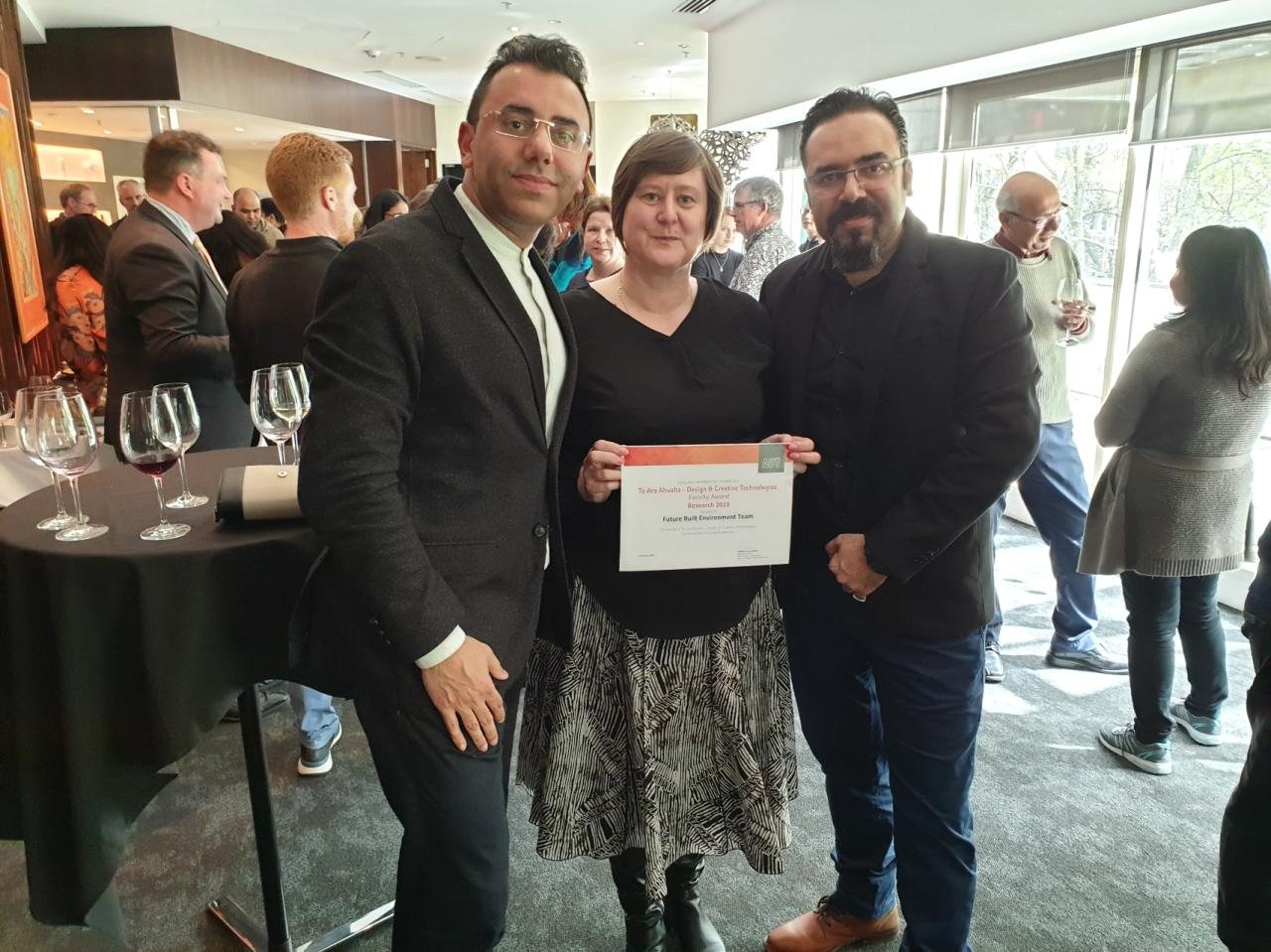
The Award
The Faculty of Design and Creative Technologies at AUT presented its Dean’s Research Team Award for 2019 to the Future Built Environment Research Team, in recognition of the team’s contribution to research in the Faculty. Professor Ghaffarian received the award with his team members Professor Amirhosein Ghaffarianhoseini and Nicola Naismith. At the time Prof Ghaffarian was Programme Director of the BE (Hons) Architectural Engineering and an Appointed Leading Researcher of the University; within a year he would lead Built Environment Engineering as Head of Department.
A Team Built Around a Shared Agenda
The team’s foundations predate the award by several years. In 2014 Prof Ghaffarian and Professor Amirhosein Ghaffarianhoseini founded the Responsive + Green Urban Built Environment Lab, a research consortium based in New Zealand, Canada and Malaysia working at building and urban scales towards healthier, smarter and environmentally responsive cities. In 2018 Prof Ghaffarian founded the Architectural Engineering Lab at AUT as a teaching and research laboratory for the Architectural Engineering major.
The team’s publications show the collaboration at work. Its members wrote together, with Professor John Tookey and others, the review of BIM uptake, its benefits, risks and challenges, since cited 1,266 times, and a critical comparison of green building rating systems, cited 966 times. In 2019 the team published nD BIM integrated knowledge based building management in Automation in Construction, with four of Prof Ghaffarian’s doctoral candidates among its authors. A shared agenda had become a shared body of work.
The Year Behind the Recognition
2019 was a year of marked momentum for the team. Four doctoral candidates completed under Prof Ghaffarian’s primary supervision, three of them in November, on Green Star and BIM, dynamic construction scheduling, BIM for complex refurbishment and the integration of BIM with building management systems. The School ran the Built Futures event for World Green Building Week with the New Zealand Green Building Council, and the team reported early results of its neuroarchitecture research using EEG and fMRI, work later consolidated in a critical review of the built environment’s impact on users’ measured brain activity.
Individual recognition arrived alongside the collective one. In 2019 Prof Ghaffarian received the DCT Research Excellence Award, became a Green Star Accredited Professional, joined the executive board of the Architectural Science Association and served as external moderator for Massey University’s Bachelor of Construction. He also delivered a keynote to the German New Zealand Chamber of Commerce on intelligent technologies and smart cities. The team award recognised the collaborative engine behind that year.
Leadership Within a Collective
Universities reward individuals more readily than teams, yet most significant research is collaborative. Faculty team awards recognise that reality and the leadership it demands: sharing credit, building capacity in junior colleagues and students, and sustaining a common agenda across many projects. Prof Ghaffarian’s contribution to the team lay as much in that capacity building as in his own outputs. His doctoral candidates were authors on the team’s papers, and the Vice Chancellor’s Doctoral Scholarships he secured, including for Dr Dat Tien Doan and Dr Marcela Brauner, funded research that became part of the team’s output.
The team’s supervision model made that capacity building concrete. Doctoral projects were supervised jointly across its members: Dr Brauner with Professor John Tookey and Nicola Naismith, Dr Doan with Nicola Naismith, Professor Amirhosein Ghaffarianhoseini and Professor Tookey, and Dr Megan Burfoot, whose doctoral scholarship began in 2019, with Nicola Naismith and Professor Amirhosein Ghaffarianhoseini. Shared supervision gave candidates access to complementary expertise and gave the team continuity as its members took on wider responsibilities.
The collaboration with Professor Amirhosein Ghaffarianhoseini in particular has proved especially durable, extending across a decade of joint publications, laboratories and conferences.
Recognition in Context
The team award sits within a cluster of recognition that marked the turn of the decade for Prof Ghaffarian. Alongside the 2019 Research Excellence Award, the Faculty named him a DCT Champion in 2020 and presented him with its Outstanding Doctoral Award the same year, and his work received best paper awards at IConBEE2018 and CONVR2020.
Publishers had already recognised the reach of that writing. In 2018 Prof Ghaffarian’s papers were the most read and second most read in Architectural Science Review and among the most read in Intelligent Buildings International, and the research was featured in the CIBSE Intelligent Buildings Group newsletter in London over several rounds. A year earlier, the work had appeared in the 60th Anniversary Special Edition of Architectural Science Review. The Dean’s award was the Faculty’s acknowledgement of a team whose standing was already visible internationally.
What the Team Went On to Build
The award proved to be an early marker rather than a culmination. In 2020 Prof Ghaffarian chaired ANZAScA 2020, the 54th conference of the Architectural Science Association, and edited its proceedings, Imaginable Futures, with Professor Amirhosein Ghaffarianhoseini and Associate Professor Nicola Naismith. In 2022 Prof Ghaffarian and Professor Amirhosein Ghaffarianhoseini guest edited Emerald special issues on digital twins and future construction; in 2024 they jointly chaired SASBE 2024 with CIB W116; and in 2025 they founded the GDI conference series.
The neuroarchitecture strand matured into a special issue of Intelligent Buildings International, a Neuroarchitecture Virtual Reality Lab and an NZD 100,000 study of mental health and AI in New Zealand classrooms. Prof Ghaffarian was appointed Head of the School of Future Environments in 2026. The Future Built Environment Research Team’s agenda remains the core of the School’s research today.