The Occasion
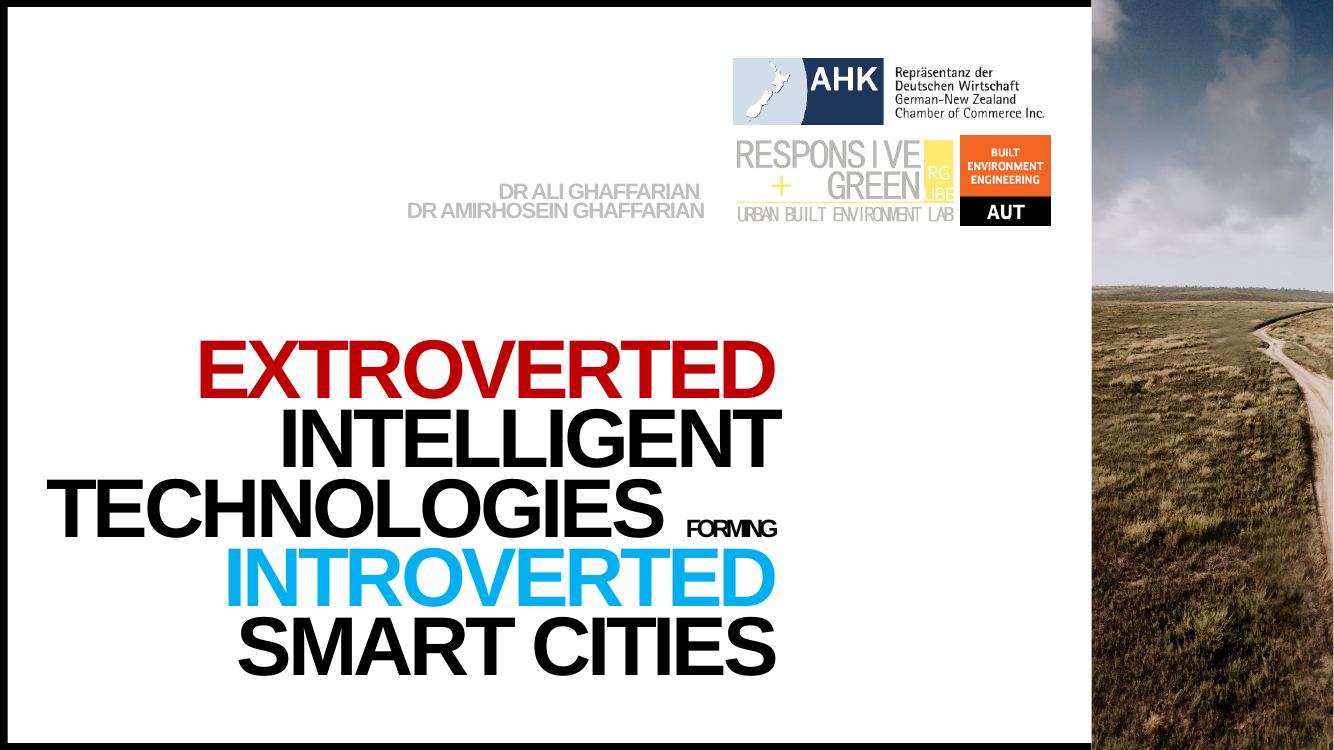
On 5 November 2019 the German New Zealand Chamber of Commerce convened its Business Conference on Energy Efficient Solutions for Urban Infrastructure at the Jet Park Hotel in Māngere. The conference introduced New Zealand businesses to German energy efficiency technologies and opened the way to partnerships between German and New Zealand firms. Speakers included Dr Ulrike Stopka of Dresden University of Technology on integrated smart mobility, Tobias Knahl of the Hamburg Chamber of Commerce, Pramesh Maharaj of EECA and Dr Anna Berka of Massey University. Professor Ghaffarian delivered the keynote with Professor Amirhosein Ghaffarianhoseini, a year after the 2018 keynote that had first brought the two to the Chamber’s platform.
Your comments were especially helpful to the German companies exploring the New Zealand market.
German New Zealand Chamber of Commerce, letter of thanks
The Argument of the Title
The title, Extroverted Intelligent Technologies Forming Introverted Smart Cities, carried the argument in compressed form. Intelligent technologies are extroverted by nature: they sense, connect and optimise across networks that reach well beyond any single building. The keynote proposed that their purpose should be the opposite movement, cities that turn inward toward their residents, built from self sustaining neighbourhoods with less dependence on a congested centre. On this view the measure of a smart city is not the density of its devices but the quality of local life those devices make possible.
The keynote grounded the proposition in Auckland’s own pressures: its standing in the 2019 Mercer quality of living ranking set against housing affordability, ageing infrastructure and the need to upgrade public transport. It then made the claim that distinguished it from a technology pitch. Technology alone would not answer those pressures; cultural change in how people travel and live, and government incentives for sustainable lifestyles, mattered as much. The model it put forward was a city of integrated neighbourhoods complementing one another, with equal access to facilities, education and employment, and it insisted that the advantages and challenges of such a model be evaluated before any proposal was endorsed. Looking to the future of energy conservation, it also made the case for remote working schemes, months before the pandemic made them routine.
The insistence on evaluation before endorsement is characteristic. Prof Ghaffarian’s citation record rests on critical review articles that test claims against evidence, from green building energy performance to the uptake of BIM, and the keynote brought that discipline to a commercial audience that might otherwise have expected a straightforward case for adoption. The same stance appears in a short paper by the two professors and colleagues on the current status of the construction industry in Auckland, published in Intelligent Buildings International in 2020 under the pointed subtitle Are we doing enough? Read together, the keynote and the paper make one argument: that Auckland’s difficulties are structural and cultural as well as technical, and that the city will become smarter only if technology is introduced in service of a coherent urban strategy.
The Research Behind the Address
The argument rests on a published position that Prof Ghaffarian and Professor Amirhosein Ghaffarianhoseini had developed over many years. Their critical exposition, Intelligent or smart cities and buildings: a critical exposition and a way forward, published in Intelligent Buildings International in 2018 and cited 100 times, questions the habit of equating intelligence with the accumulation of technology and asks what such systems are for. Their earlier analysis, What is an intelligent building?, has become the most read article in the history of Architectural Science Review, with 51,627 views on the publisher’s site and 270 citations.
The social dimension of the title has equally deep roots. The 2013 review of the essence of future smart houses that the two professors wrote with colleagues, cited 240 times, traced the move from embedding information technology in the home to adapting the home to sustainability principles, the same shift from device to purpose that the keynote applied to the city. Work from 2011 on local smart housing and on culturally responsive intelligent buildings had already argued that intelligence must answer to the society that inhabits it.
The remote working argument also had a research basis. Earlier in 2019 Prof Ghaffarian led a paper at CAADRIA 2019 in Wellington on holographic transportation in smart offices as a route to more efficient working patterns, and in February 2019 he and colleagues wrote on planning for smarter cities for the industry readership of Build magazine. The keynote drew these strands into one proposition for the Chamber’s audience.
A Voice for Trade and Technology Transfer
The Chamber’s response is the clearest measure of the keynote’s value. Prof Ghaffarian granted the German Federal Ministry for Economic Affairs and Energy rights to use the presentation in its public relations work, and the Chamber wrote afterwards to thank him, noting that his comments had been especially helpful to the German companies exploring the New Zealand market. An academic keynote rarely earns that kind of reception from a trade audience. It did so here because it offered what visiting firms most needed: an independent, evidence based reading of the city they hoped to serve, including the cultural and policy conditions their technologies would meet.
For AUT the engagement placed built environment research in front of an international trade network at a moment when Prof Ghaffarian was Programme Director of the BE (Hons) Architectural Engineering and Industry Engagement Coordinator for the Architectural and Construction Engineering degree, roles in which connection with industry was central. The same year he received the Faculty of Design and Creative Technologies Research Excellence Award, recognition within the university that matched the external invitation.
From Keynote to Research Programme
The keynote anticipated a research agenda that Prof Ghaffarian went on to build at AUT. He led the Smart Cities and Infrastructure Research Cluster until 2026, and in 2020 co-led the Future Energy Landscapes Working Group of the APRU Sustainable Cities and Landscapes Hub. Doctoral work under his co-supervision has since examined how digital twins can improve wellbeing in smart cities through New Zealand’s Living Standards Framework, published as a wellbeing oriented framework for urban digital twins in Cities, and how microclimate and outdoor thermal comfort vary across Auckland.
The central claim of 2019, that the smart city should be judged by what it does for its neighbourhoods, has remained a constant in Prof Ghaffarian’s public writing, from Why Auckland Needs to Become Smarter to Auckland Needs Fifteen Minute Lives, Not Imported Models, and in his later keynote on cities as living, sensing bodies at TU Delft. Read in that sequence, the 2019 keynote is an early and complete statement of a position that has since matured into policy commentary and international scholarship.
The Complete Presentation