A Publishing Model Built for Finality
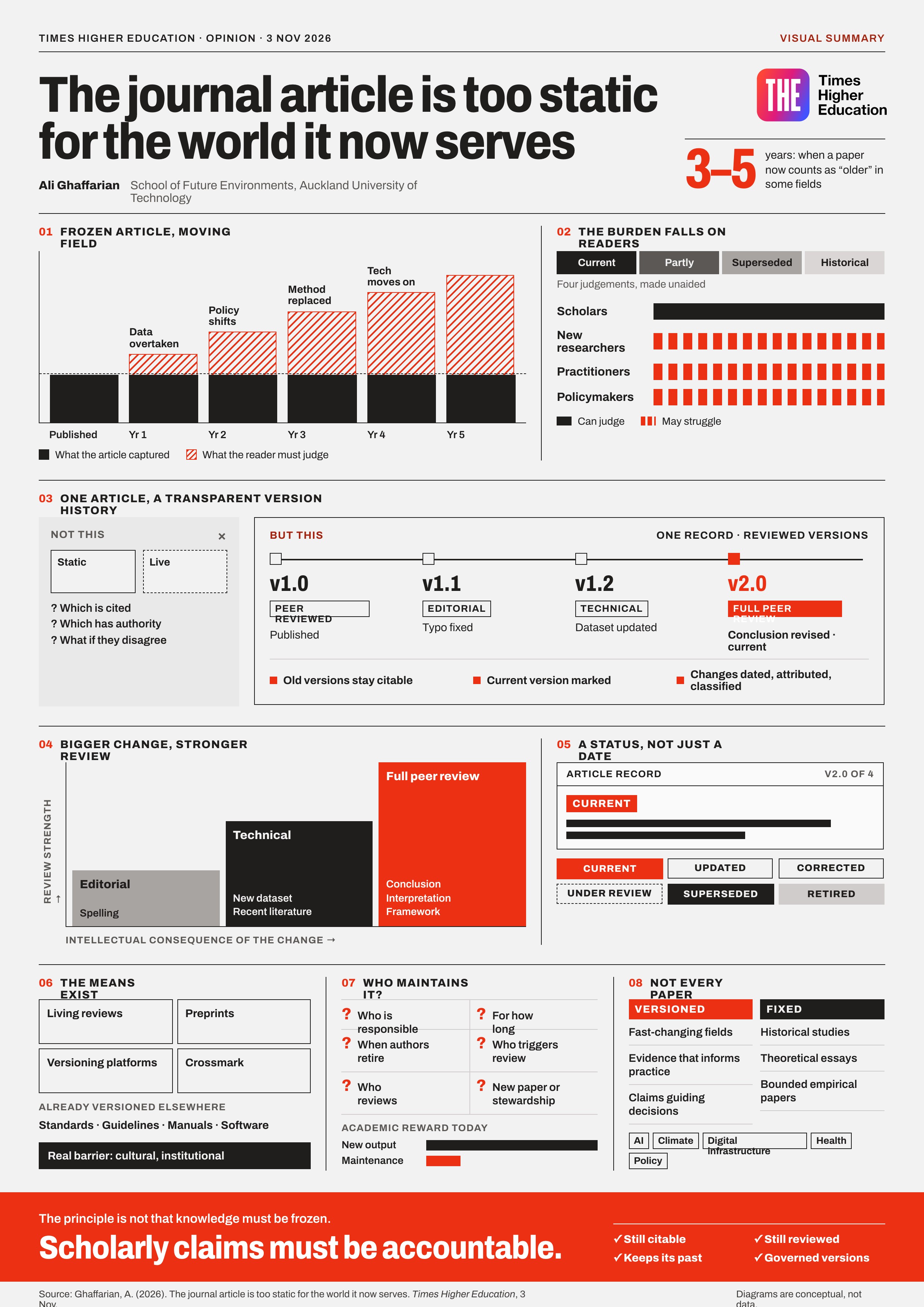
The argument begins with the advice Professor Ghaffarian gives research students, to treat papers more than 3 to 5 years old with care in fields shaped by artificial intelligence, climate transition, digital infrastructure, health evidence and public policy. The same students are then sent to a publishing system that treats an accepted article as finished, open to correction or retraction but otherwise frozen.
In his view the fixed record exists for good reasons, since citation and accountability both depend on it. What he questions is the assumption that a sound paper stays complete while datasets are overtaken, methods replaced and policy settings changed around it. Students, practitioners and policymakers are left to judge for themselves whether a paper is current, partly current or superseded, and the article itself rarely helps them.
The principle is not that knowledge must be frozen. The principle is that scholarly claims must be accountable.
Times Higher Education, 3 November 2026
One Article, a Governed Record of Versions
Professor Ghaffarian sets aside the idea of parallel static and live articles, which would leave readers unsure which one to cite or trust. He proposes a single scholarly object that moves through reviewed versions. Earlier versions remain accessible and citable, the current version is clearly marked, and every change is dated, attributed and classified as editorial, technical or fully peer reviewed.
The depth of review would follow the intellectual consequence of each change, so that a spelling correction, an updated dataset, newly added literature and a revised conclusion each meet a different level of scrutiny. Readers would see a status beside the publication date, such as current, updated, corrected, superseded, under review or retired.
He points to living systematic reviews, preprint servers, open review platforms and Crossmark as parts of this system already in use, and to standards, technical manuals and software, whose authority rests on clear rules for change.
Stewardship as Scholarly Work
The harder obstacles, he argues, are cultural and institutional. Journals and universities would need to settle who is responsible for an article after publication, how long authors keep it current, who decides whether an update needs peer review and how that review is recognised. Because the academic reward system values the next output above the reliability of the last, he calls for the upkeep of influential articles to count as real scholarly labour.
The proposal is deliberately bounded. Historical studies, theoretical essays and tightly bounded empirical papers can remain fixed, and the case is strongest where research changes quickly and evidence informs practice directly.
Part of a Wider Agenda
The article carries into research publishing the position behind his invited address “From Static to Dynamic: Built Environment Education in the Age of Agentic AI” for the eighth CIB President’s Seminar Series, which sets out how education should operate in a sector whose practice now changes within months.
Featured in the THE Newsletter
The Times Higher Education newsletter selected the article for its Opinion section, introducing it as a case for letting scholars update published research papers to reflect emerging trends in their field. The selection brings the proposal to the publication’s readers across higher education.
