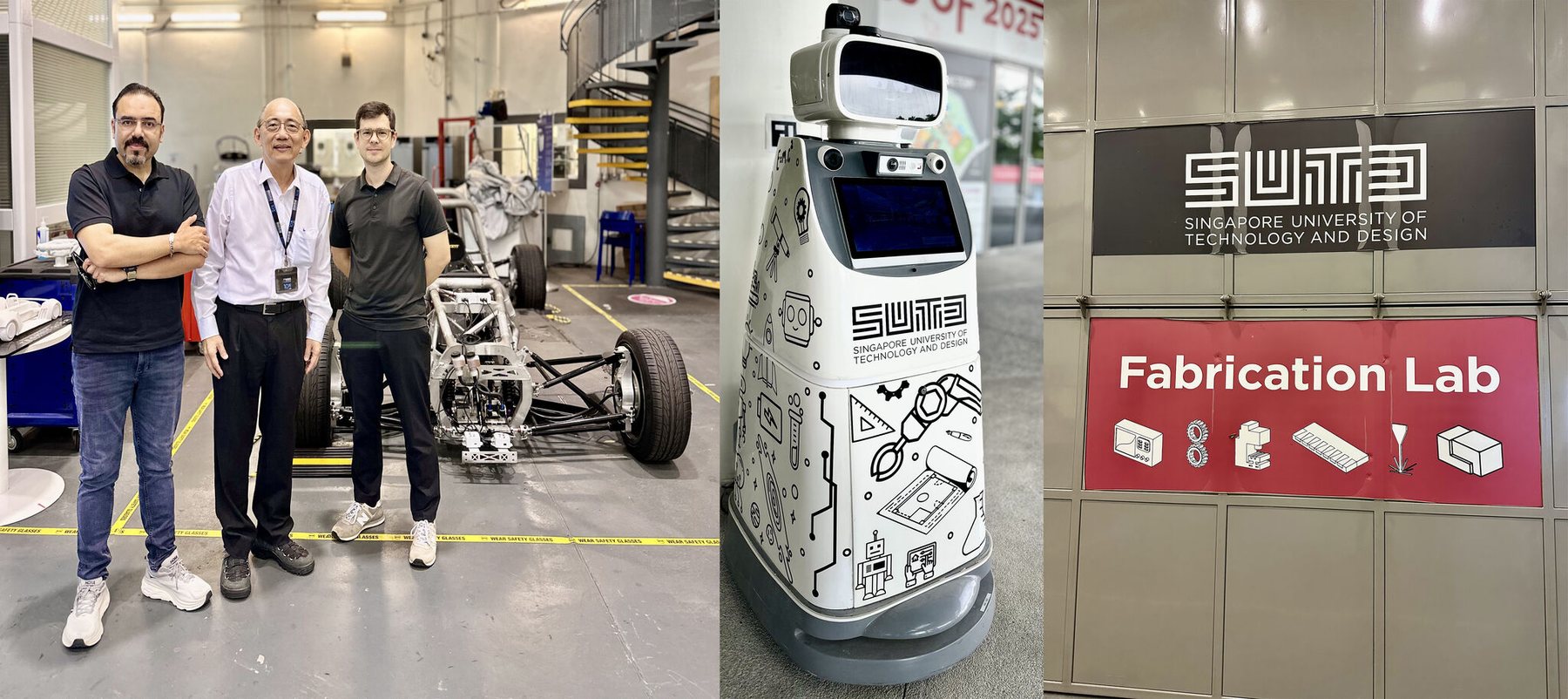
The Occasion
Professor Ghaffarian travelled to the Singapore University of Technology and Design in June 2025, then serving as Head of Department, Built Environment Engineering at AUT. His hosts were Assistant Professor F. Peter Ortner, coordinator of SUTD’s Master of Architecture and PhD programmes in Architecture and Sustainable Design, and Professor Lim Seh Chun, former Provost of the university. The programme combined senior level discussion with a tour of SUTD’s facilities, including its fabrication laboratory. Prof Ghaffarian set out his reflections in a public account of the visit published on 6 July 2025.
Reading an Institutional Model
What struck Prof Ghaffarian most was not only the intellectual energy of the campus but the boldness with which SUTD, as a young institution, has claimed a place in the global academic and innovation community. In a short time it has built a compelling narrative around design led interdisciplinary learning, rooted in relevance, agility and ambition. That observation is the judgement of an academic leader who has spent a career building exactly this kind of integration. Prof Ghaffarian trained in architectural engineering before completing his MSc and PhD in Architectural Studies at Universiti Putra Malaysia, and he has worked ever since at the point where design meets engineering.
At AUT that conviction took institutional form. Prof Ghaffarian developed eight programmes, directed the BE (Hons) Architectural Engineering from 2018 to 2020 and carried it through its first Engineering New Zealand accreditation under the Washington Accord. A university that has made interdisciplinarity its identity rather than an aspiration is therefore a natural interlocutor, and the parallels with the School of Future Environments were immediate: a shared commitment to sustainability and emerging technologies, comparable visions for future focused architectural education, and a willingness to teach design and engineering together in ways that universities organised around separate faculties often find difficult.
The lesson of the visit concerns identity as much as curriculum. SUTD demonstrates that a young university need not imitate older institutions to earn international standing; it needs a clear proposition, expressed consistently in its programmes, research and facilities. The same conviction runs through Prof Ghaffarian’s subsequent leadership. As Head of the School of Future Environments since January 2026, he leads more than 100 academic and professional staff across Architecture and Built Environment Engineering and has realigned the School’s academic portfolio around those two disciplinary cores. A School defined by the meeting of design and engineering, rather than by a list of departments, is the model the Singapore conversations brought into sharp focus.
Common Ground in Research
The visit rested on substance as well as affinity. One of Prof Ghaffarian’s most cited works, a state of the art review of urban heat island mitigation strategies in Kuala Lumpur, Singapore and Hong Kong, published in Cities in 2017, has been cited 577 times. The review treats Singapore as one of three reference cases for heat mitigation in dense Asian cities, a question close to SUTD’s own sustainable design agenda.
The connection runs through Prof Ghaffarian’s supervision as well. His doctoral candidate Dr Damiloju Adeyina completed a thesis in 2023 on the passive house framework in cooling dominated climates, having presented a Singapore case study to the Asia Pacific Solar Research Conference. In 2024 a Master of Construction Management project under his supervision asked whether BIM should be mandatory in New Zealand, learning from Singapore’s journey. Add the RG UBE Lab, which Prof Ghaffarian founded in 2014 with Professor Amirhosein Ghaffarianhoseini and which works across New Zealand, Canada and Malaysia, and the visit was the extension of a decade of Southeast Asian scholarship rather than a first contact.
Digital construction offers further common ground. Prof Ghaffarian’s review of BIM uptake, its benefits, risks and challenges has been cited 1,266 times, and his guest edited special issue on enabling the development and implementation of digital twins placed AUT within the international conversation on the digital management of buildings and cities. SUTD’s fabrication laboratory speaks to the same agenda from the side of design and making.
Singapore as a Reference Point for Aotearoa
Singapore has become one of the world’s reference points for planning, building regulation and digital government. Its national consent and building information platforms show how a small, well governed country can lead in digital construction, and Prof Ghaffarian later drew on that experience in his commentary on New Zealand’s building consent reform. The relevance is practical. Prof Ghaffarian serves as National Committee Advisor (Academia) to BIMinNZ, the single advisory seat its terms of reference reserve for a university voice, and as an Evaluator for MBIE. Firsthand understanding of how a peer nation has organised its digital building systems strengthens the advice he brings to those national forums.
A university partner in Singapore also offers access to a research community that works at the scale of the whole city, and to a policy environment in which planning, regulation and digital government are closely joined. For a School whose research spans smart cities, digital twins and climate adaptation, that is precisely the kind of comparative setting in which New Zealand questions can be tested.
Strategic Significance for the School
The visit belonged to a deliberate pattern of international engagement in 2025. In the same month Prof Ghaffarian delivered a keynote at DFBI 2025 at TU Delft, a conference for which AUT was one of four organising institutions, and later that year he founded GDI 2025 with a senior advisory board drawn from 16 countries. His conference work now spans 33 countries on six continents, eleven of them in the Asia Pacific, Singapore among them.
Such engagement has a measurable institutional purpose. Since 2015 Prof Ghaffarian has contributed to the assessment processes of the QS and Times Higher Education rankings, and he understands how academic reputation is built across borders. In 2026 Architecture and Built Environment at AUT entered the QS World University Rankings by Subject for the first time, in the 201 to 260 band. A visit is not a partnership in itself, and none is claimed here. It is the groundwork on which partnerships are built: senior relationships, mutual understanding of institutional models, and a shared research vocabulary. With SUTD, Prof Ghaffarian established all three.